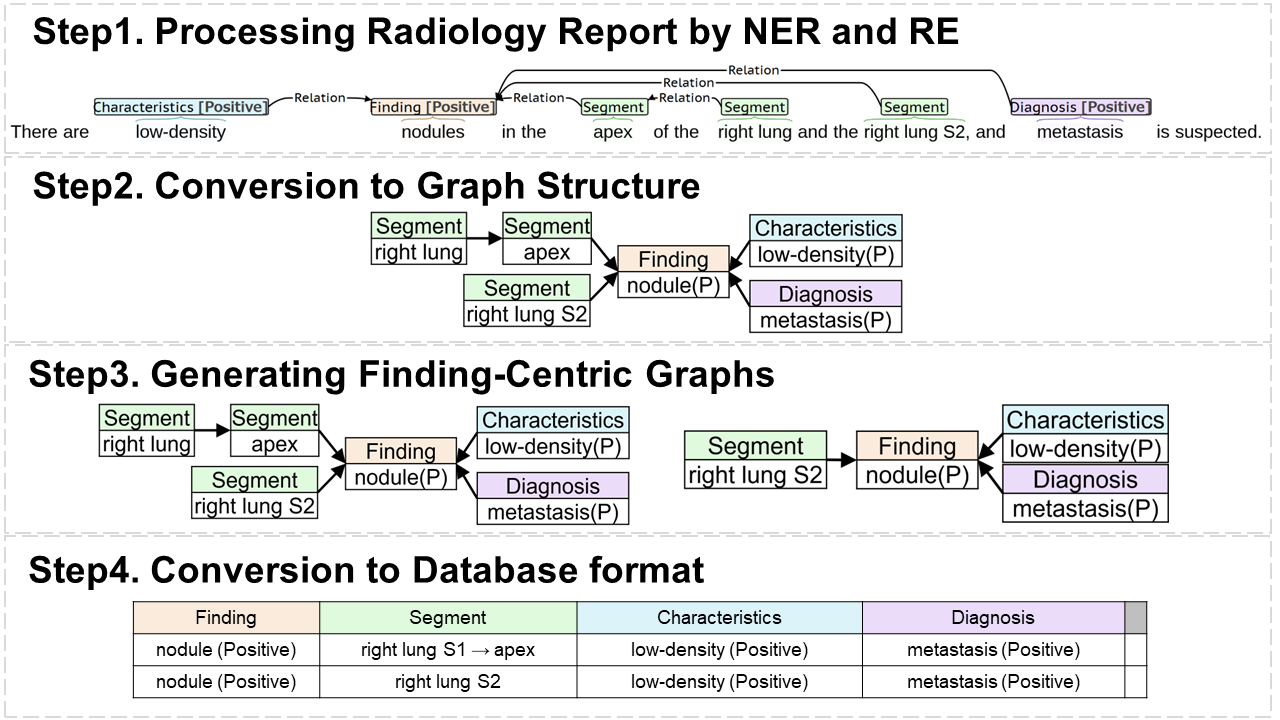
Radiology reports are comprehensive documents in which radiologists record abnormal findings and suspected diagnoses based on medical images such as CT and MRI scans. Although these reports provide valuable insights that reflect physicians’ thought processes, their free-text format makes it difficult to directly utilize the information for secondary applications.
The paper introduces a “Finding-Centric Structuring” approach, which organizes radiology reports around individual abnormal findings. By applying techniques such as Named Entity Recognition (NER) and Relation Extraction (RE), together with graph-based rule processing, this method enables detailed organization of information for each finding, even when multiple findings are described within a single sentence. This structuring facilitates further utilization of radiology reports, such as in the development of diagnostic support systems.
In addition, this paper constructed a large-scale dataset of approximately 8,400 reports from multiple facilities and conducted performance evaluations. The results showed that models trained only on reports from a single facility exhibited performance gaps when applied to reports from other facilities. However, efficient improvements were achieved by augmenting the training data based on the identified causes of performance degradation.

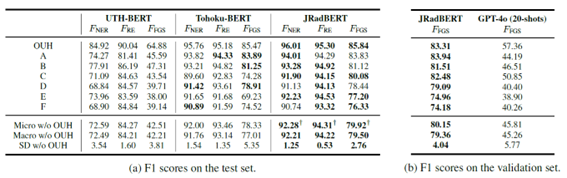
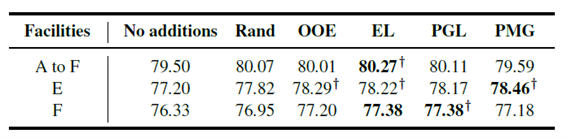
[1] Tagawa, Yuki, et al. “Finding-Centric Structuring of Japanese Radiology Reports and Analysis of Performance Gaps for Multiple Facilities.” Proceedings of the 2025 Conference of the Nations of the Americas Chapter of the Association for Computational Linguistics: Human Language Technologies (Volume 3: Industry Track). 2025.
DOI: 10.18653/v1/2025.naacl-industry.7
CAUTION:This is Fujifilm Global Website. Fujifilm makes no representation that products on this website are commercially available in all countries. Approved uses of products vary by country and region. Specifications and appearance of products are subject to change without notice.