Background
In MRI, parallel imaging, which acquires data by undersampling to shorten scan time, is widely used. However, increasing the undersampling rate causes the g-factor, which arises from coil sensitivity distribution, to become spatially non-uniform, resulting in spatially non-uniform noise where noise intensity varies significantly across the image. Such noise leads to image quality degradation and reduced diagnostic performance. Recently, CNN-based denoising methods for MRI images have been proposed, but many of these methods assume spatially uniform noise and thus struggle to effectively reduce noise in high g-factor regions where non-uniform noise is prominent. Therefore, there is a demand for noise reduction techniques specifically addressing the spatially non-uniform noise characteristic of parallel imaging.
Approach
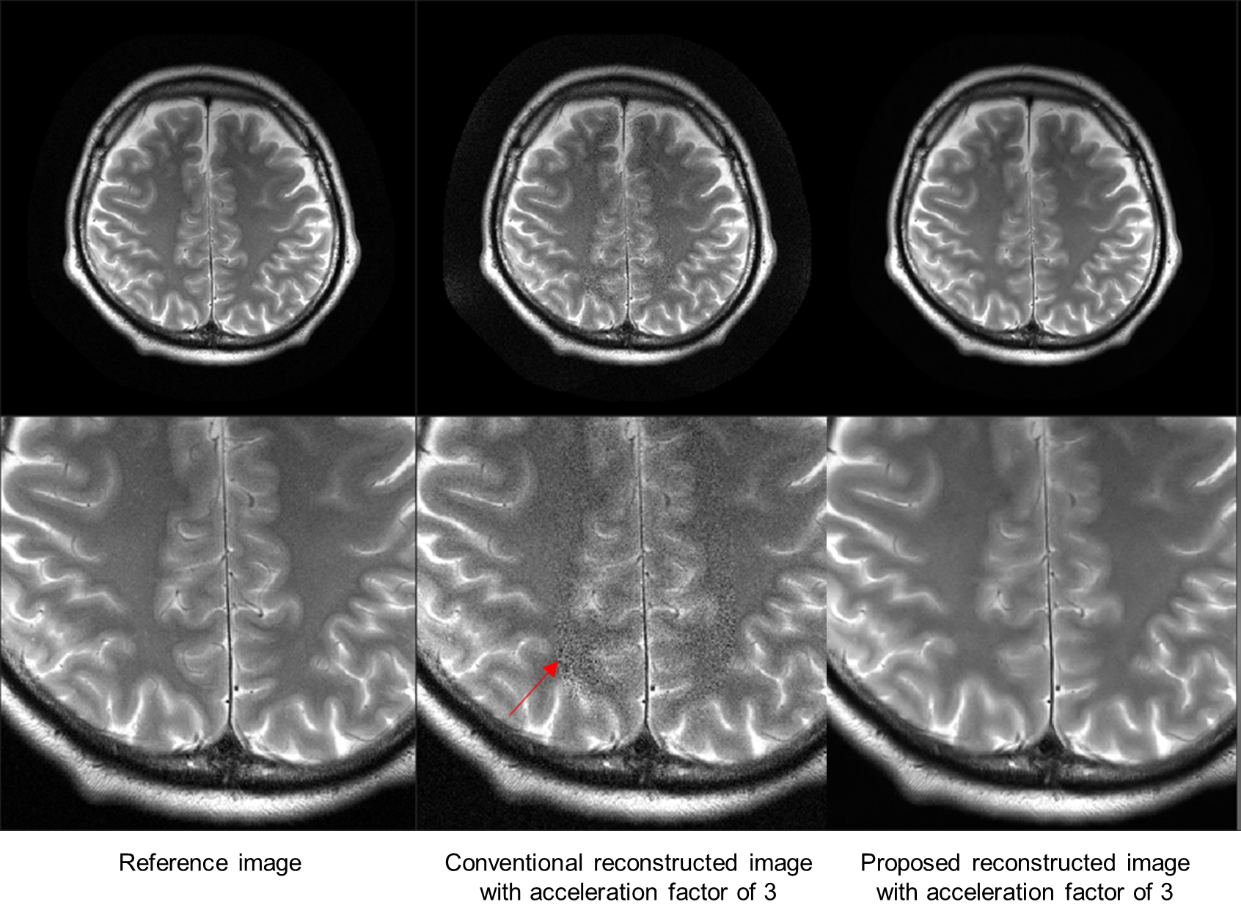
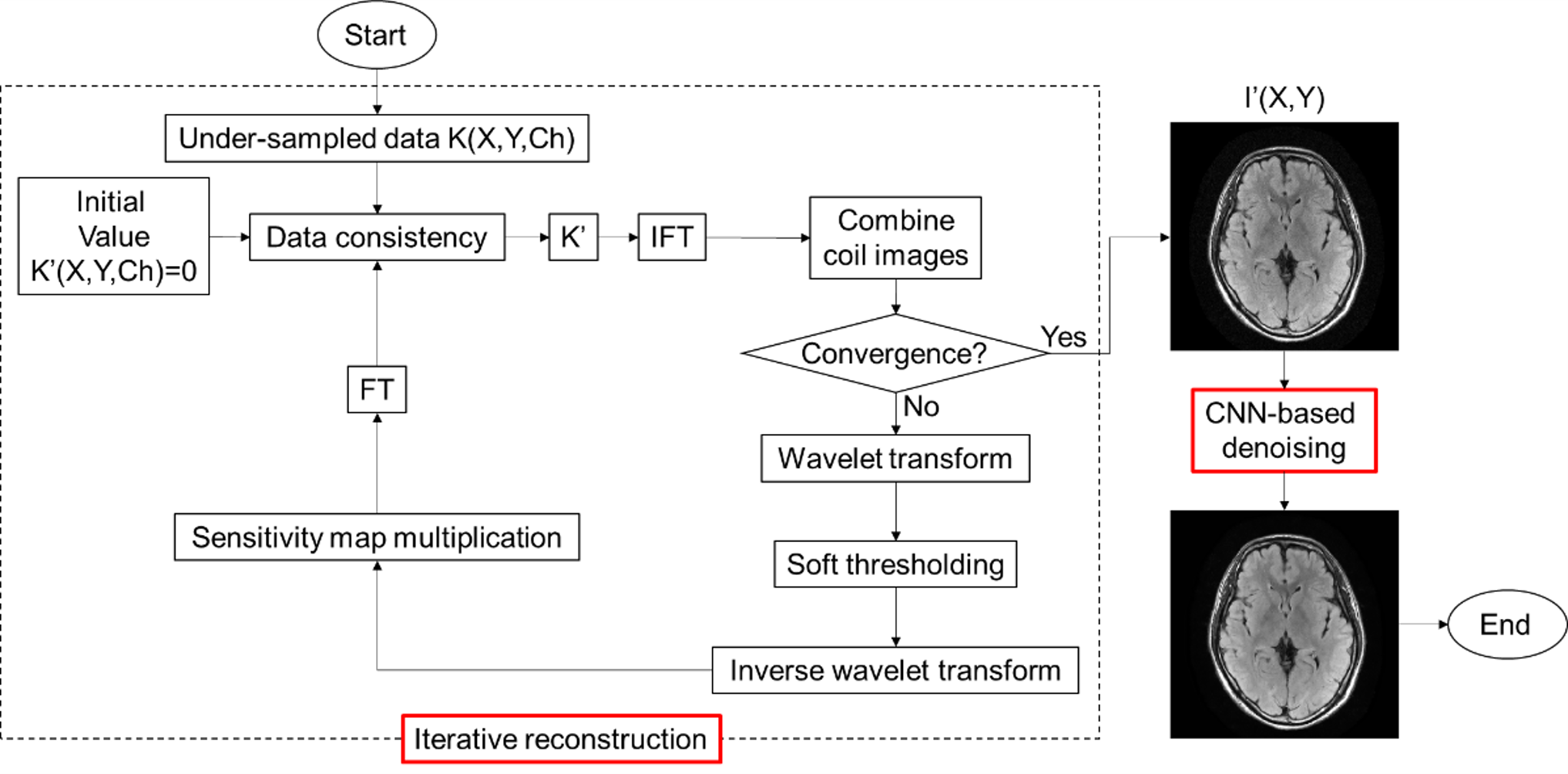
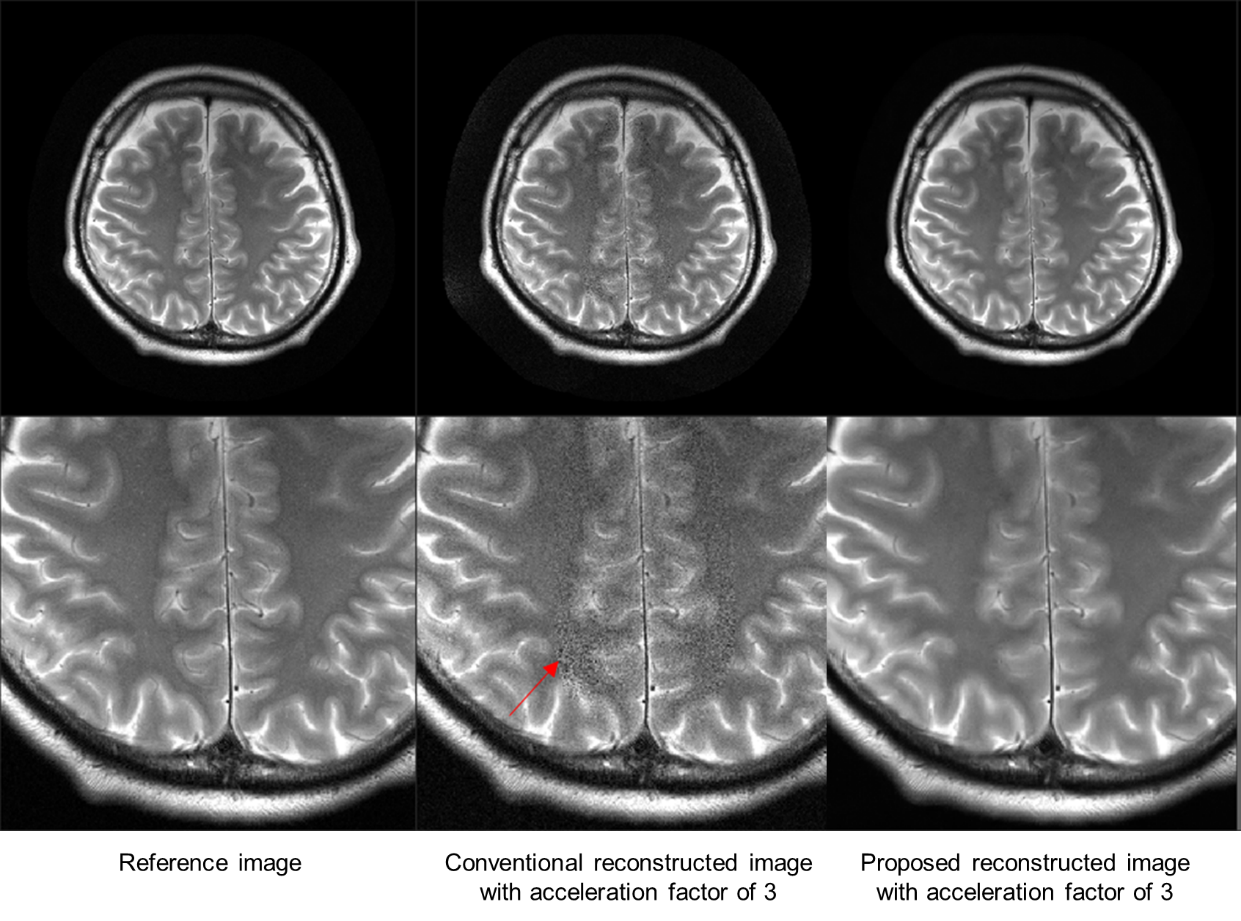
The paper [1] introduced here proposes a method that combines iterative reconstruction with CNN-based denoising to progressively reduce spatially non-uniform noise. First, an iterative reconstruction based on the POCS method incorporates soft-thresholding in the wavelet domain to suppress noise amplification during iterations while reducing the spatial non-uniformity of noise caused by the g-factor. Subsequently, CNN-based denoising is applied to the residual noise, which has become relatively spatially uniform, to further improve image quality (Figure 1). The proposed method features a two-stage structure that assigns the roles of noise homogenization and CNN denoising separately. When the scan time is reduced to one-third, conventional reconstruction methods exhibit spatially non-uniform noise, whereas the proposed method successfully reduces this non-uniform noise (Figure 2).
Summary
This paper presented an effective solution to the clinically important issue of spatially non-uniform noise in MRI parallel imaging by complementarily combining iterative reconstruction and CNN-based denoising. In particular, it was confirmed that the proposed method can reduce the non-uniform noise that arises when the scan time is shortened to one-third.
[1] Atsuro S, Tomoki A, Yukio K, Toru S, Combination of Iterative Reconstruction and CNN-Based Denoising for Non-Uniform Noise for Parallel Imaging in MRI, Medical Imaging Technology, 2023, Volume 41, Issue 1, Pages 37-51
DOI:https://doi.org/10.11409/mit.41.37
CAUTION:This is Fujifilm Global Website. Fujifilm makes no representation that products on this website are commercially available in all countries. Approved uses of products vary by country and region. Specifications and appearance of products are subject to change without notice.