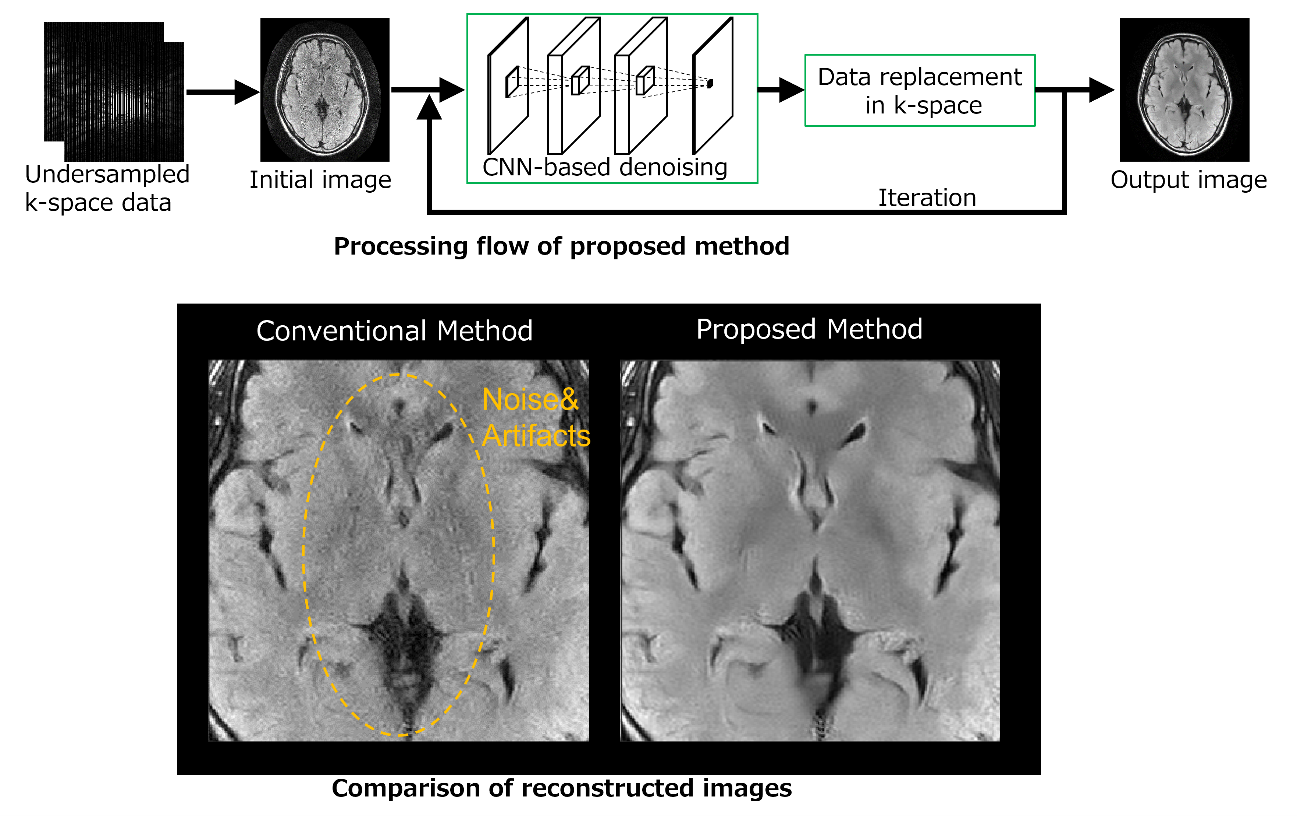
Parallel imaging (PI) is widely used to shorten MRI acquisition time by undersampling k-space data, but higher reduction factors lead to increased noise and artifacts due to reconstruction processes. Conventional iterative reconstruction methods based on sparsity can reduce noise; however, they struggle to separate true signals from noise at high reduction factors.
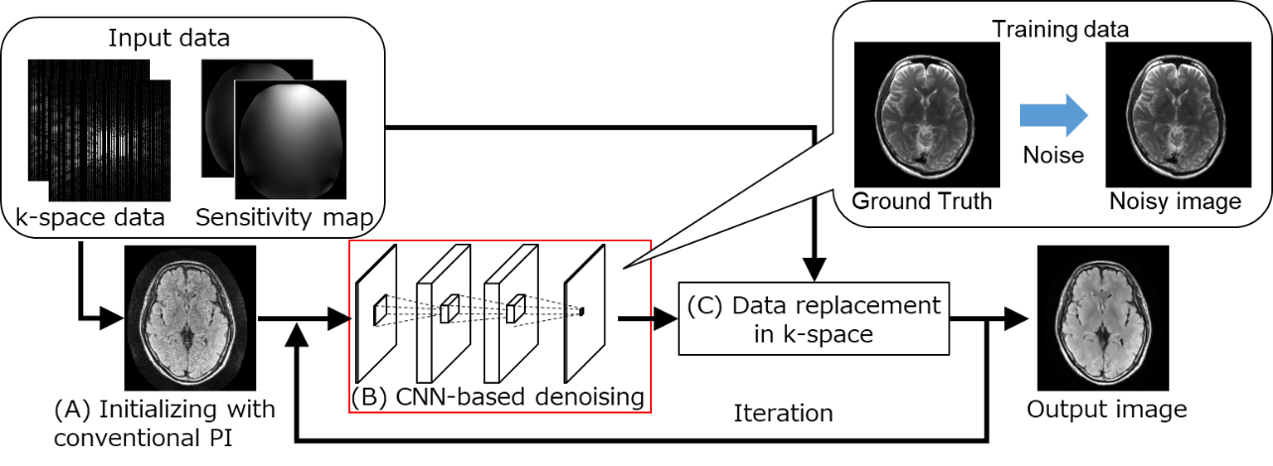
In this study[1], we propose an iterative PI reconstruction method that combines CNN-based denoising in the image domain with data-consistency processing in k-space. The CNN is trained using pairs of clean and noise-added images to effectively distinguish signal from noise. Experimental results using brain FLAIR images demonstrated that the proposed method reduces noise and artifacts more effectively than both conventional PI and sparsity-based iterative reconstruction methods, achieving lower reconstruction error.
These results indicate that CNN-based denoising is effective for improving robustness and image quality in accelerated MRI.
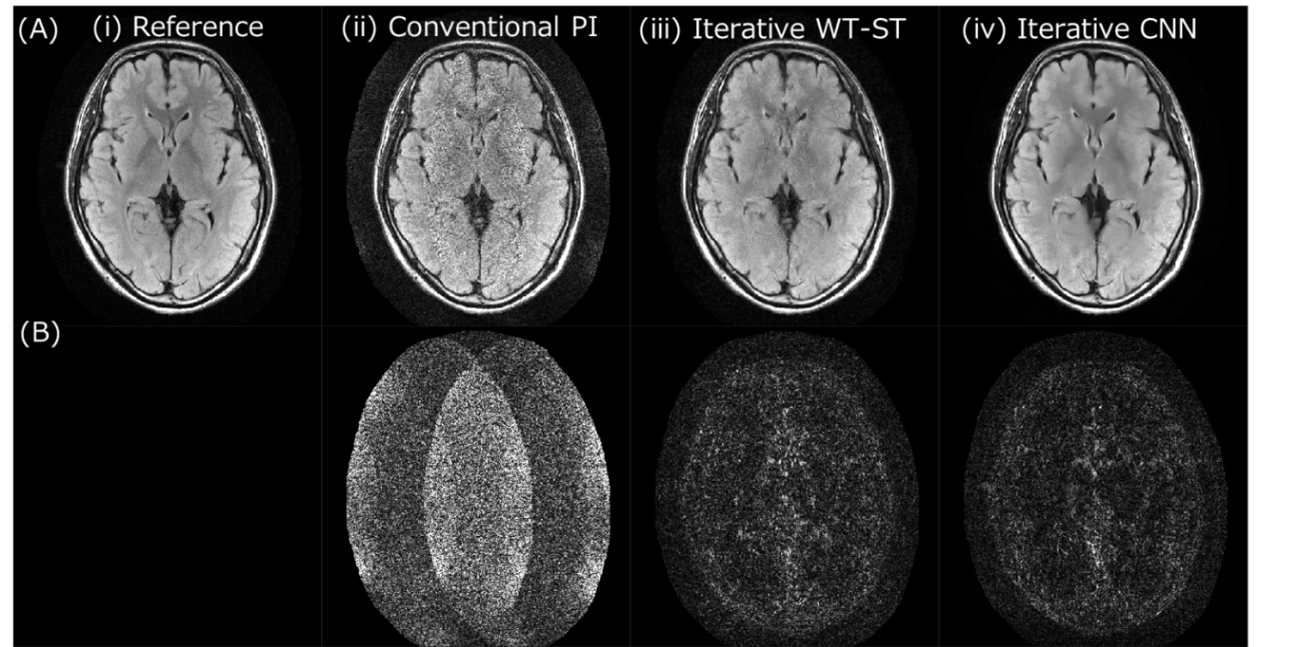
(A) Reconstructed images from (i) PI reconstruction without under-sampling for reference, (ii) conventional PI method without denoising, (iii) conventional sparse reconstruction method, and (iv) proposed method. (B) Absolute difference from reference image.
DOI:https://doi.org/10.58530/2023/4771
CAUTION:This is Fujifilm Global Website. Fujifilm makes no representation that products on this website are commercially available in all countries. Approved uses of products vary by country and region. Specifications and appearance of products are subject to change without notice.